- 289.813.1969
- 1.844.564.1076
- info@furtherafieldtravel.ca
You are here
NEWGRANGE - OLDER THAN THE EGYPTIAN PYRAMIDS
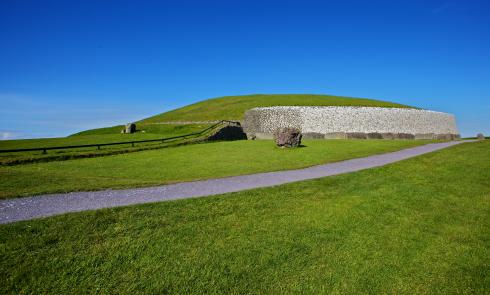
The Neolithic passage-tomb at Newgrange Co. Meath. The monument has been carbon dated back to 3,200 years B.C. that’s over 5,200 years ago. Why was it was built?
This has been a topic of conversation and discussion since its discovery in 1699. Before we delve deeper into Newgrange we have to mention the amount of megalithic tombs in Ireland, passage tombs, wedge tombs, portal tombs, and court cairns. The remains of over 1,000 such tombs have been recorded everywhere. As one travels through the country, you’ll notice mounds on hilltops, standing stones, and ring forts. Some are believed to be Fairies Forts with the entrance leading to the underworld, particularly at Celtic Festivals times. The oak trees also have a semblance and association with the fairies or the little people. The Gaelic word for Oak is Doire, and throughout the country there are a lot of place names with the word Doire in them.
Newgrange, or Bru ‘Na Boinne’ is one of the most important Neolithic visitor attractions sites in the country, older than Stonehenge in England and the Pyramids of Egypt. Since the 1960s other sites have been unearthed and have been added to the tour programmes. Architectural studies have found cremated remains, bones and other artifacts within these places. The tombs may have served as an astrological observation location, or a spiritual, religious and ceremonial centre of importance. The site chosen by the banks of the River Boyne wasn’t just by chance. The river is of major importance in Ireland. Before the advent of roadways, rivers were the means of getting to destinations. Ports were built at the mouth of a river and so on. It was a vital 112 Km-long artery of historical, cultural, and ecological significance. The stories that are attributed to the River are many. A sacred landscape, close by is ‘The Hill of Tara’, the site of ‘The High Kings of Ireland’, the sites where various sections of the armies involved in ‘The Battle of the Boyne’ fought in 1690.
The mythological tale of The Salmon of Knowledge, the poet Finegas had spent 7 years trying to catch a salmon in the River Boyne, there was a prophecy foretold that whoever tasted the fish first would gain the knowledge of the world. One day Finegas and his apprentice Fionn Mac Cumhaill were fishing, Finegas caught the salmon, building a fire to cook a scrumptious meal with some wild herbs added in, that had been growing nearby. The salmon was placed on two sturdy sticks, Fionn was ordered to make sure the fish didn’t burn, turning it over once too often he burned his finger. Nature being what it is he stuck his finger in his mouth, the result was that he had tasted the fish and accidentally or not he had consumed the knowledge, resulting in him becoming the wisest man in Ireland.
This tale is frequently used as a symbol of the University of Notre Dame graduation community.
After the Battle of the Boyne in 1690, the land on the east coast which was in Catholic ownership was confiscated by the Government of King William III and the Protestant-dominated Irish Parliament. Don’t forget that during the Cromwellian Plantation an enormous amount of land had also been confiscated in a similar way across the southern part of the country. The land where Newgrange is, was occupied by Charles Campbell who held a 99 years lease on the land. He had decided to lay out roads and fence off sections to rent out to tenant farmers. His workmen were removing rocks from a mound when they discovered an entrance to the passage and chamber. This was 1699. Associates of Campbell visited the site and recorded evidence from the tomb, different studies revealed various archaeological history of Irish antiquarianism. Campbell’s lease ended in 1799, people still visited the site, but because of the damage that the workers had done the area remained in ruins.
Professor Michael J O’Kelly was a lecturer in Archaeology at University College Cork from 1946 until his death in 1982. As well as a professor his hobby was archaeology. He worked at some local sites around his native Co. Limerick. He was offered a position in Newgrange in the summer of 1962 with a group of likeminded people helping him. The work continued until 1975, during that time the builders discovered that the passage in Newgrange is deliberately oriented so that each year around the time of the Winter Solstice December 21, the rays of the rising sun shine through the roof box over the entrance and illuminate the floor of the passageway into the inner chamber that consists of three recesses each containing carved stone basins, that held human remains. The corbeled roof is 6 metres high and has remained watertight for 5,000 years. The team that worked with Professor Kelly were made up of 3 University students from Sweden, 2 from Harvard, 2 from University College Cork, and 2 local labourers. The restoration work was funded by the Irish government under the guidance of the Office of Public Works. The Board of Works of the United Kingdom was established in 1831 and functioned as a British authority when carrying out work in Ireland. With Irish Independence the Office of Public Works was put in place and now continues this role.
The Winter Solstice draws an enormous number of visitors to the Newgrange Monument all year round. For the actual date of the Solstice December 21, visitors who were at the site during the previous season have their names included in a Lotto draw to see if they’re lucky enough to be present for the Solstice.